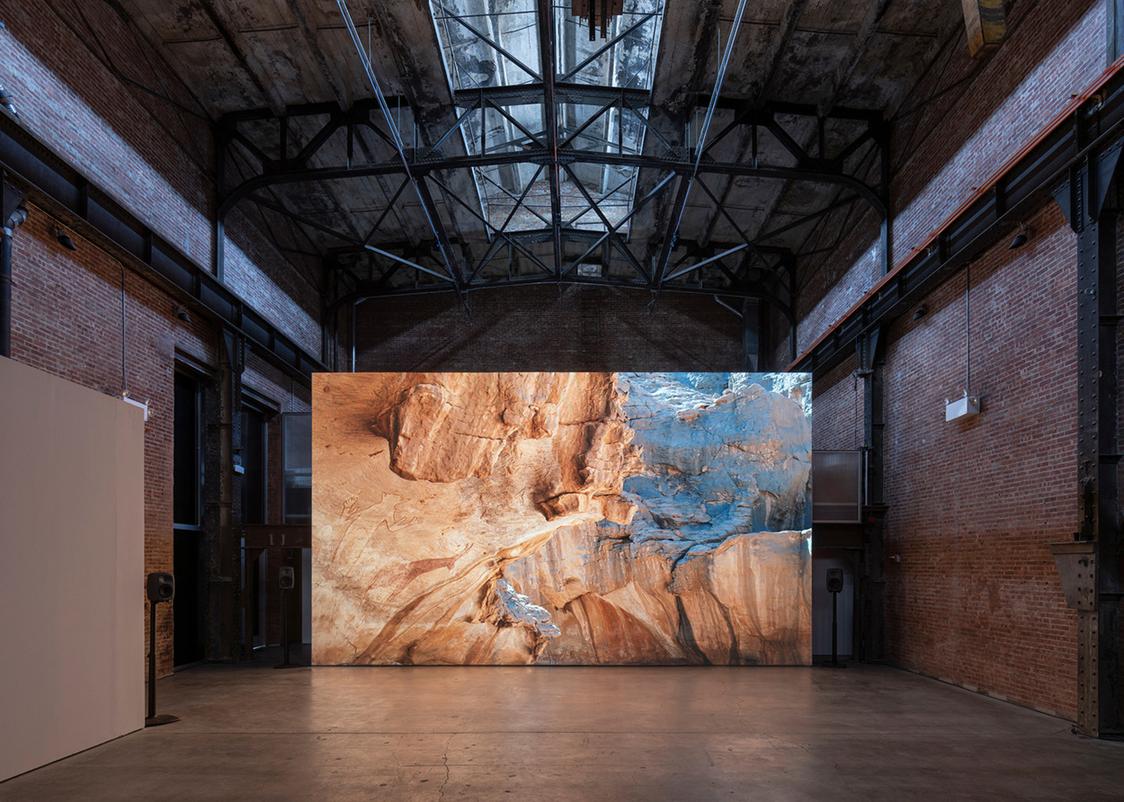
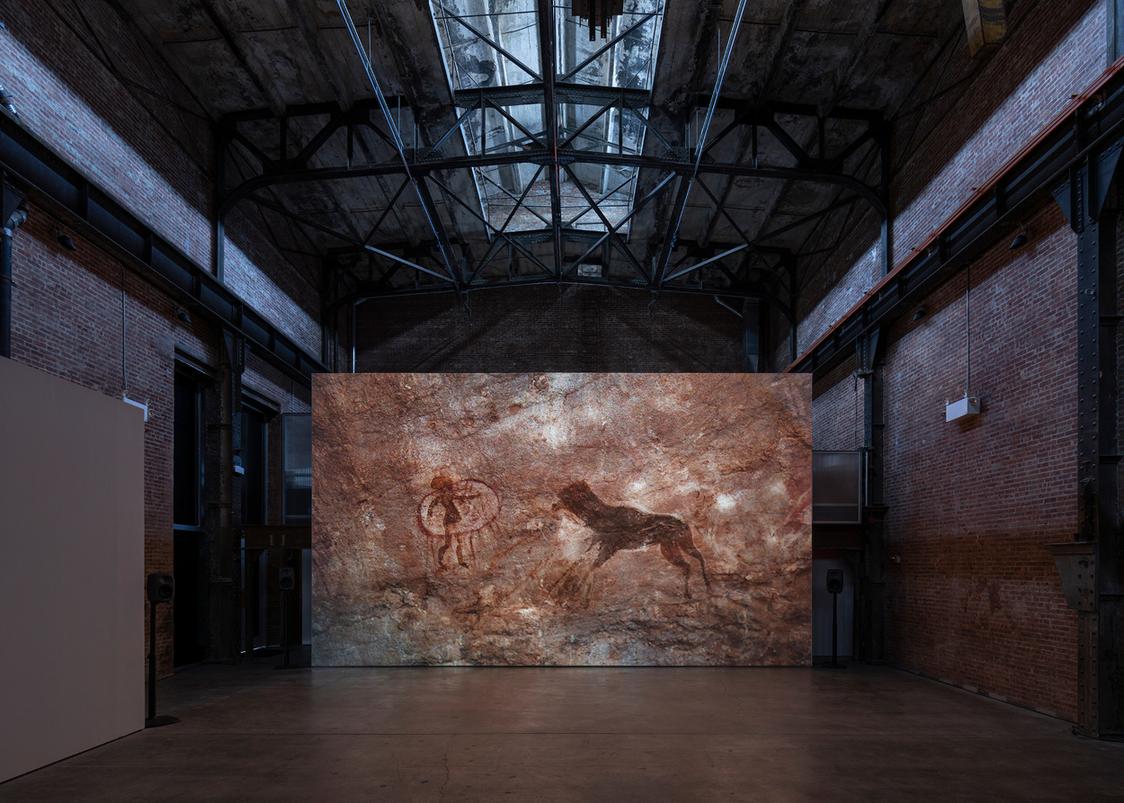
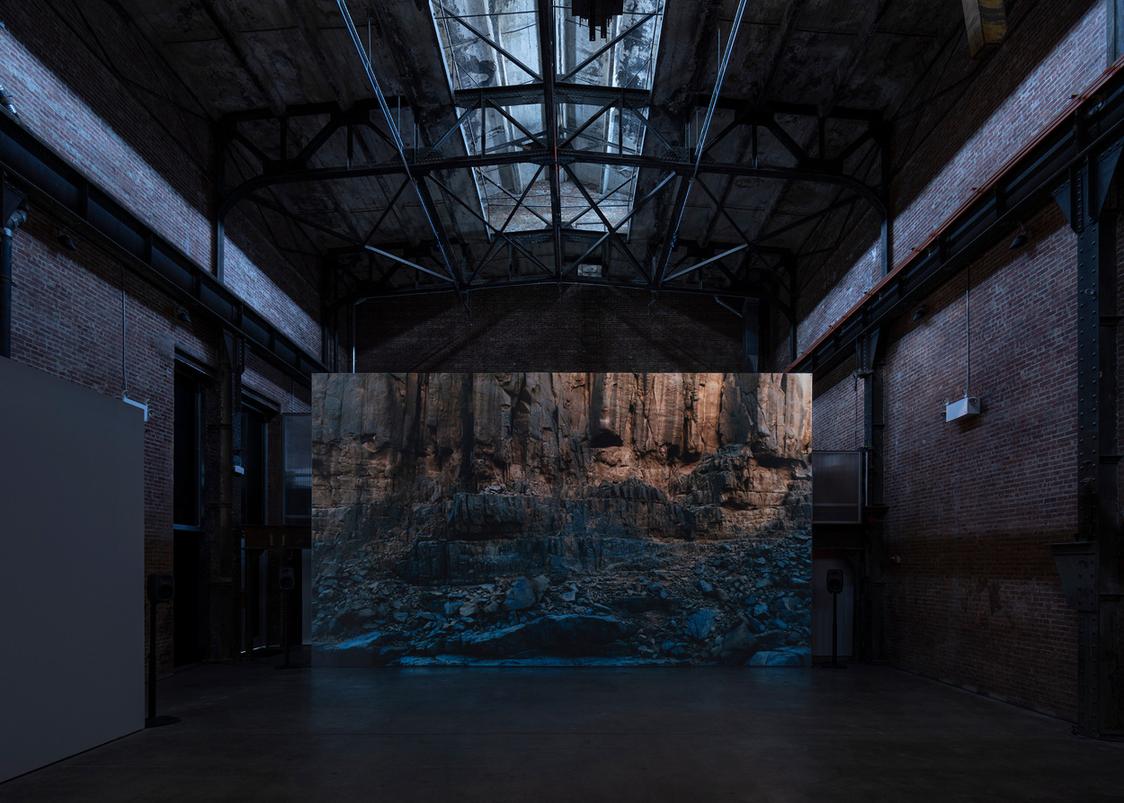
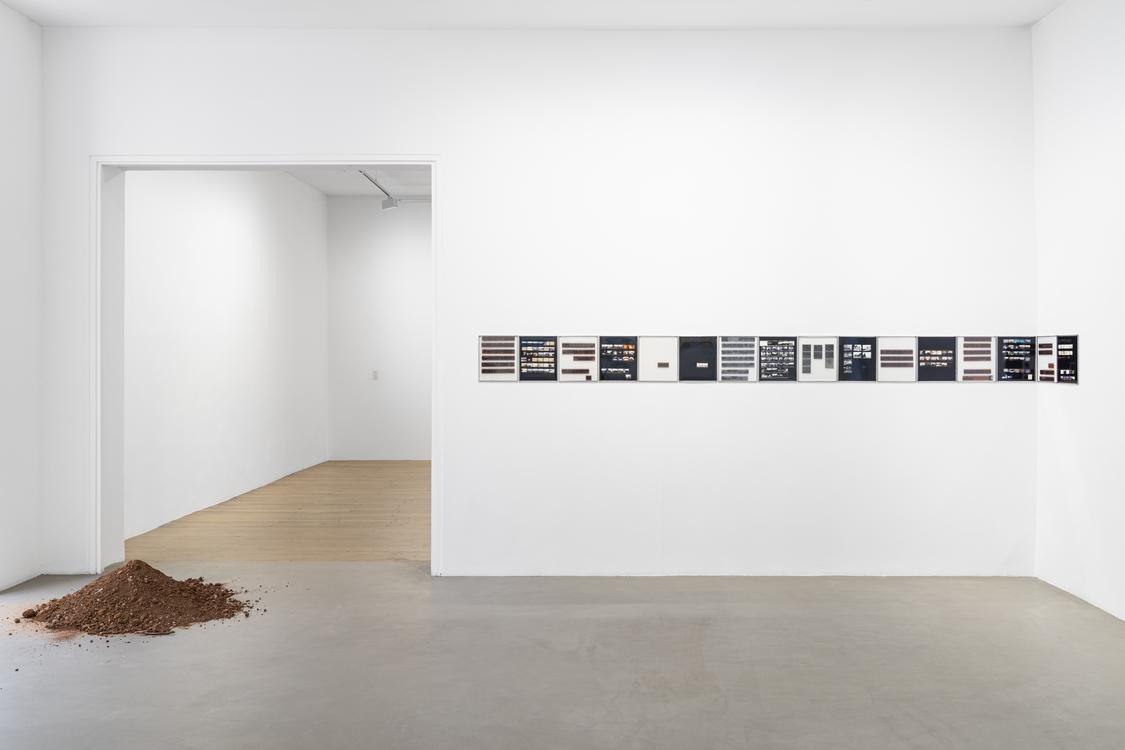
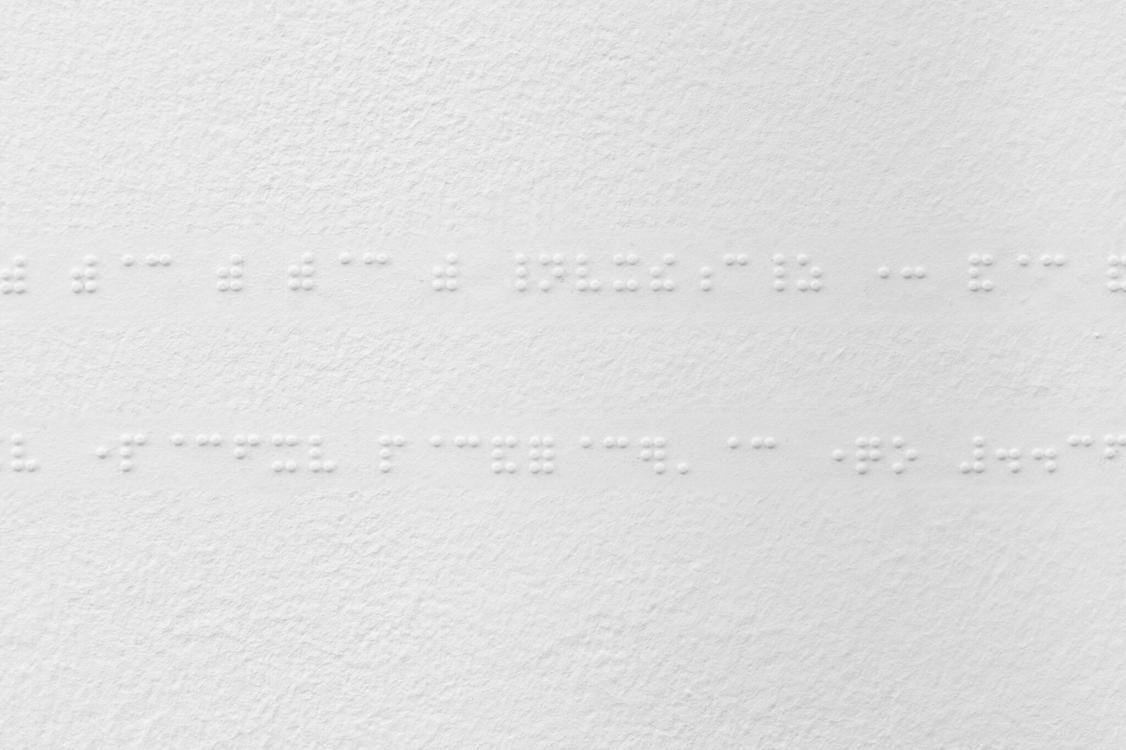
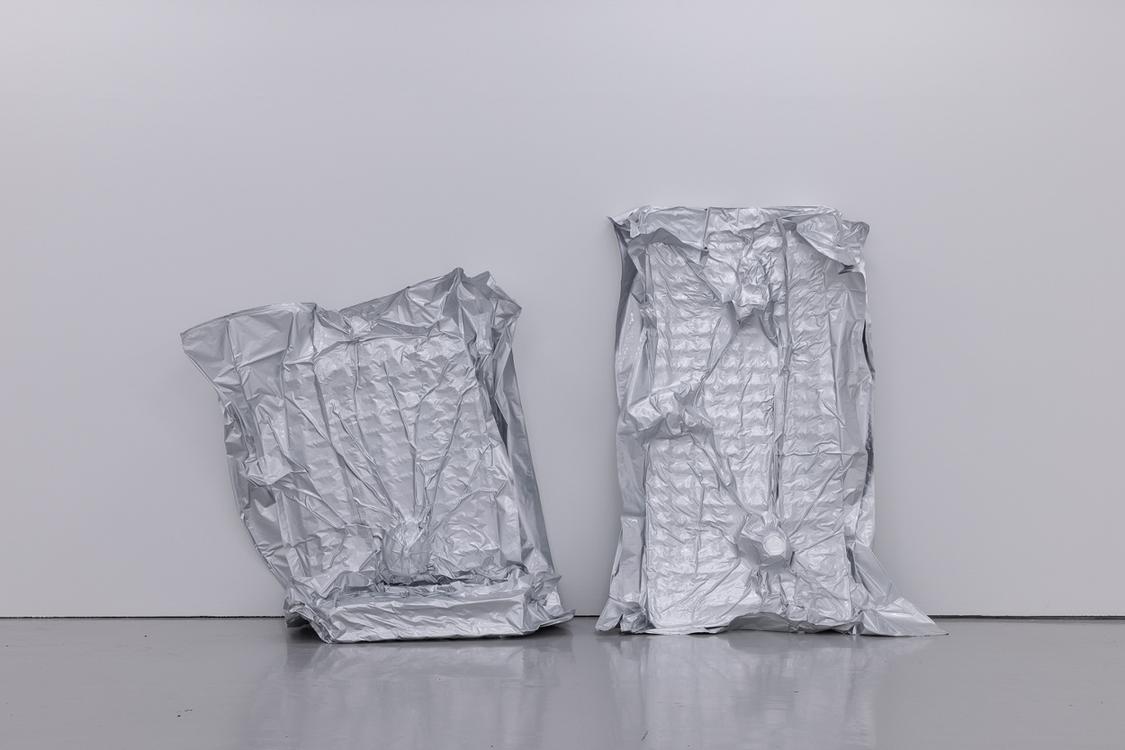
Lydia Ourahmane’s works often began as large, open-ended propositions that found the edges of possibility within the political, environmental, and metaphysical conditions in which she operated. Tassili was an engagement with a remote desert, how and why one traveled there, and the conditions of image production. Specifically it was about Tassili n’Ajjer, a largely inaccessible plateau near the border between southeastern Algeria and Libya. After a labored administrative process, Ourahmane and a group of collaborators traveled on foot through this region to produce a new moving image work, also titled Tassili, and to gather scans that later informed a new sculpture. These works and the political positions they represented comprised her exhibition at SculptureCenter. Tassili n’Ajjer was host to thousands of prehistoric engravings and cave paintings that described the transformation of life in the Sahara over thousands of years. The earliest appeared between 8,000 and 6,000 BCE. Across a network of caves, scenes of conflict and ritual submitted to a drastically altered ecological landscape, once a fertile “bed of rivers,” as the translation of its name implied, and now an arid and inhospitable expanse of desert. Ourahmane’s film subsumed an encounter with a hypnotic array of this imagery – of ancient demons, extraterrestrials, and lost rivers and forests – while moving through a place that both collapsed and measured the severity of time.
The oldest period of rock art of the Central Sahara was referred to as Kel Essuf. Essuf was a term used by the Tuareg people to refer to the desert wilderness, or to a sense of the unknowable – as an internal, psychological state, or in reference to the demon figures that appeared in the drawings of the later Round Head Period, before depictions of animal husbandry and daily life appeared in following centuries. For Ourahmane, making a film was a pretense to engage with the spiritual dimensions of the plateau – a place marked by depictions of ancient rites that offered a long view of a relationship between people and the environment. Traveling in the desert was a way to interrogate questions around belief and trust, two evolving dynamics in her recent work, and what it meant to physically put oneself in a space where one could not navigate or survive without acquiescing to a radically different relationship to time and place.
Her project also posed a number of immediate questions, the first of which was whether or not this kind of image making – retreading paths of colonial-era archaeology and relying on local knowledge to support intellectual, spiritual and artistic objectives – was a neocolonial endeavor, even when undertaken by one whose perspective and personal experience reflected a sharp and critical attention to related legacies of colonial oppression. These were enduring concerns in Ourahmane’s recent work of and about Algeria, where she was born in 1992.
Tassili both obscured and heightened the contradictions of Ourahmane’s artistic and political position. The film itself was vibrant and seductive. Extended passages shot in first-person perspective traversed a striking landscape at walking pace, with footage edited together across days and nights. Ourahmane combined these point-of-view shots with seemingly static footage, night vision recordings, and sequences transferred from 16mm film.
A roughly forty-five minute edit of this seemingly uninhibited imagery concealed the conditions that both enabled and controlled its gaze. To travel in Tassili n’Ajjer was to perform a strict choreography of resource management and walking routes that determined what could be perceived under extreme limitations of climate and physical endurance. These movements were in turn organized by Tuareg guides who relied on protocols of mutual trust and accountability to make safe passage across the plateau, which was sustained by a single source of water. In effect, one could only film where one could walk, with no chance to backtrack or act beyond the present moment and location.
By some accounts, Ourahmane’s effort to travel into the desert with extensive film equipment represented an impressive bureaucratic feat, a credit to the cultural legacy of the region, and a potentially critical relationship to the Algerian government’s management of this territory, its people, and its history. Ourahmane’s guides, for example, were born on the plateau but were displaced by government officials in the 1980s; now they rearticulated or performed their relationship to their previous territories by escorting groups there. In another light, Ourahmane’s undertaking could be criticized as an absurd pilgrimage not far from tourism, funded by international cultural institutions, and mobilizing a local infrastructure of previously nomadic guides in support of a group of foreigners, who were typically forbidden from accessing Tassili n’Ajjer — and all of this for the sake of producing hyper-detailed imagery of a place that had resisted representation for years. Further, the film was scored as a four-part exquisite corpse by four composers, none of whom traveled to Tassili. Ourahmane’s invitation to these close friends and collaborators put further stress on the artist’s own use of images of Tassili n’Ajjer and how wide its purview might stretch. The result was a set of divergent sonic approaches to the work’s imagery and varying degrees of compliance with the structures suggested by Ourahmane’s video editing, opening the work to another layer of ambient intervention.
Foreign depictions of Tassili n’Ajjer had a long history. Notably, the “Tassili frescoes” were conveniently “discovered” and illuminated by state-sponsored French archaeologist Henri Lhote immediately after oil deposits were found in the area in 1956, during the Algerian War of Independence. Lhote’s research methods subsequently damaged many of the drawings while advocating for France to protect world heritage sites in the Sahara, a strategy that called for continued colonial control of Algerian land and resources.
With this background, archaeology and extraction formed another dichotomy close to Ourahmane’s project. While much of her past work had involved moving objects across contexts, her exhibition at SculptureCenter explored a new approach to the mediation of site through photogrammetry, a remote sensing technology that used photographic data to accurately represent three-dimensional objects. In the film, digital animations developed from scans collected on the surface of the plateau subtly simulated passages of Ourahmane’s live footage. In other sequences, displaced fragments of landscape floated in a contextless virtual space as the camera zoomed and panned amid changing lighting effects. This kind of production privileged transportable information over the physical possession of an object or a place, evaded certain problems of extraction while creating new and ambiguous distribution channels for forensic detail.
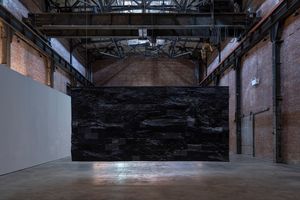
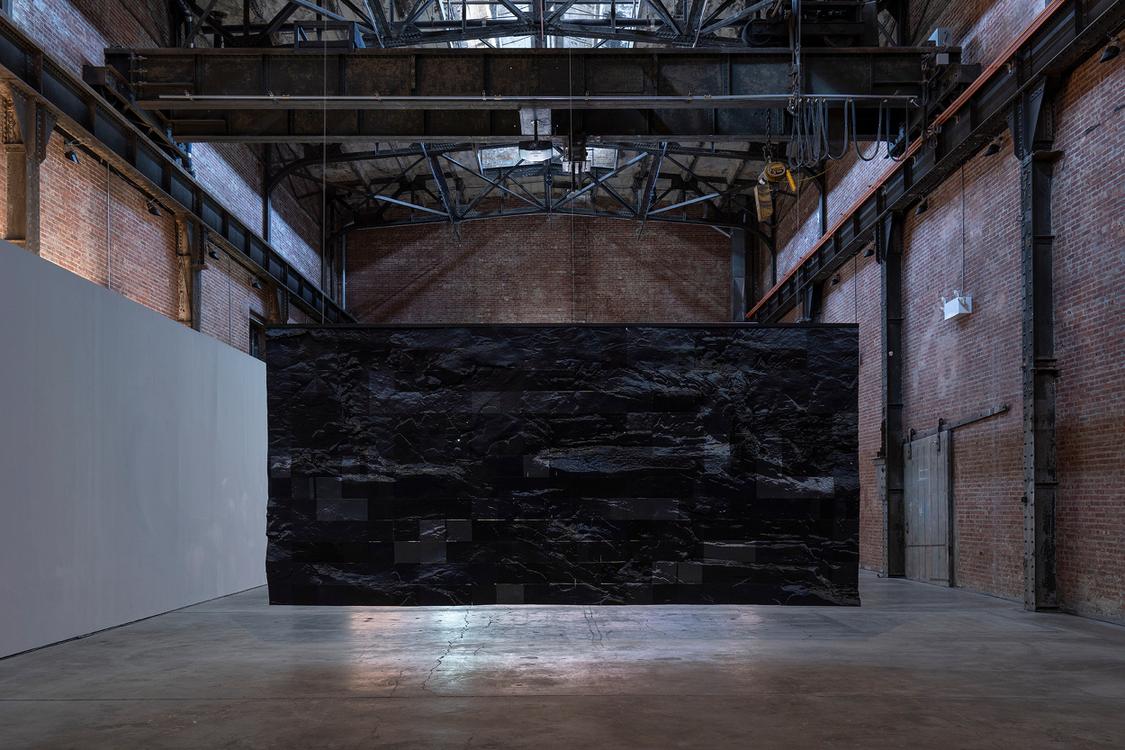
In a similar vein, a high-relief topographical sculpture produced in collaboration with Yuma Burgess replicated surface sections of the desert and was 3D-printed on site at SculptureCenter in thin tiles of black thermoplastic. The work appeared as a continuous field, suspended as a monumental screen, but in actuality it was a partially invented landscape: it collapsed the distance between multiple real sites, and it used a general adversarial network (GAN) to produce new textures that filled the space between the edges of discrete scans. Like the film, the sculpture paired excessive or indulgent visuality with speculation about what could not be seen (for a range of reasons), but could be sensed, intuited, or imagined, a feeling heightened by the reflective luster that made the work’s dark surface ambivalent.
In recent years, Tassili n’Ajjer had functioned as a major migration route across the African continent, engendering new narratives of violence, smuggling, and other security issues. In this context, and despite its own complexities, Ourahmane’s exhibition could be read as a rebuttal of recent characterizations, subtly animating writer Ibrahim Al-Koni’s more grave and poetic description of the desert as “the only place where we can visit death… Because it is the isthmus between total freedom and existence.” Ourahmane’s work similarly understood the desert, and perhaps the ambitions of art, as a means of seeing beyond the machinations of the present day while contending with the fact that we remained tightly bound to the political frameworks and material contingencies of the moment, the decade, the century, or somewhere beyond time.
more