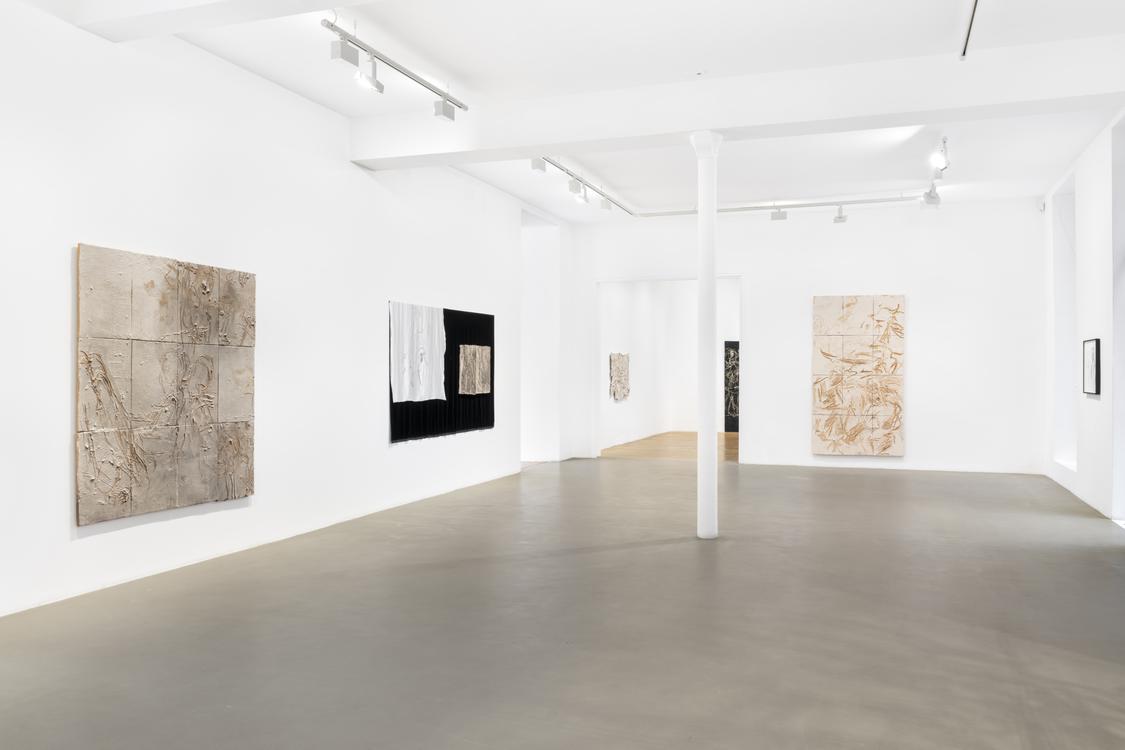
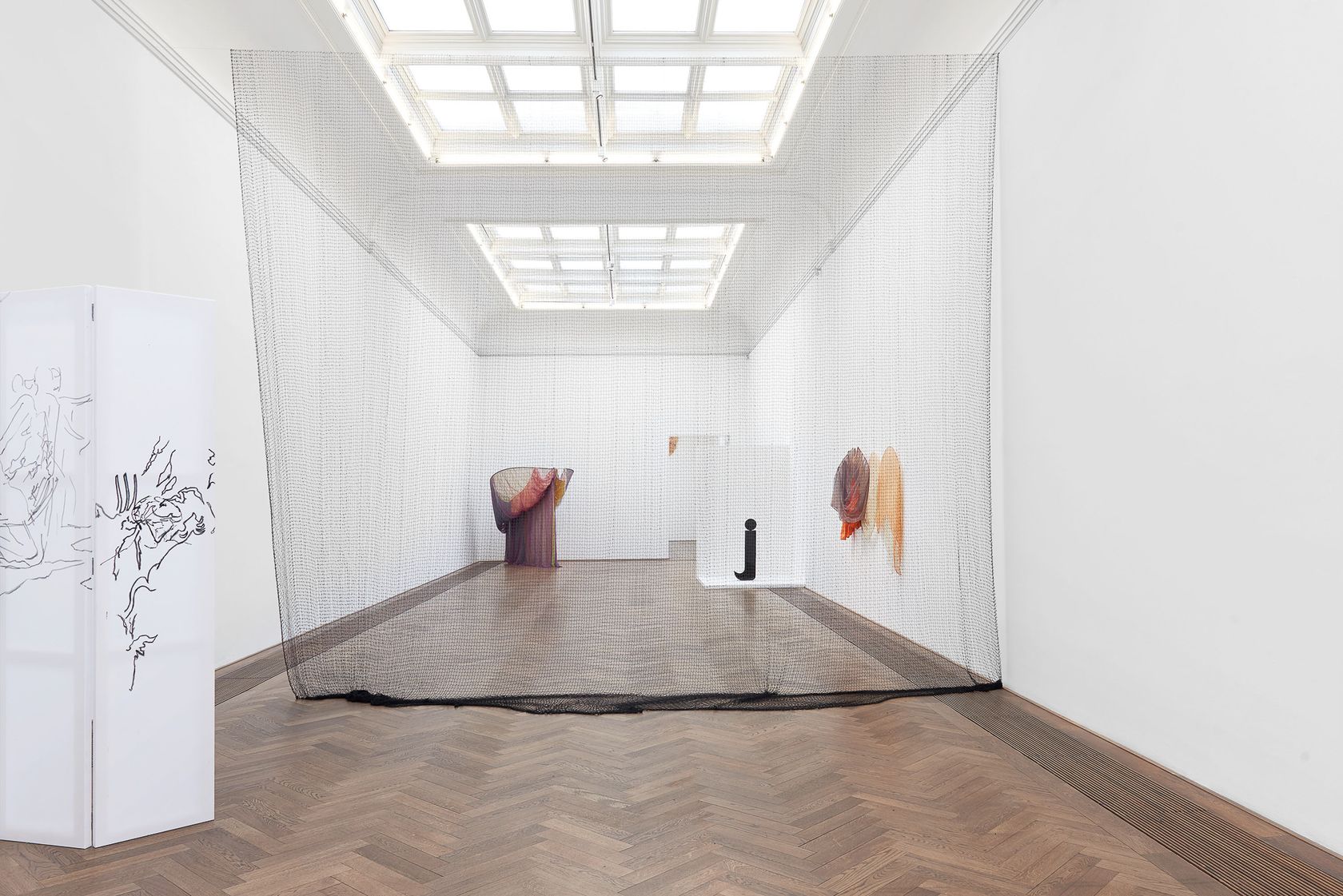
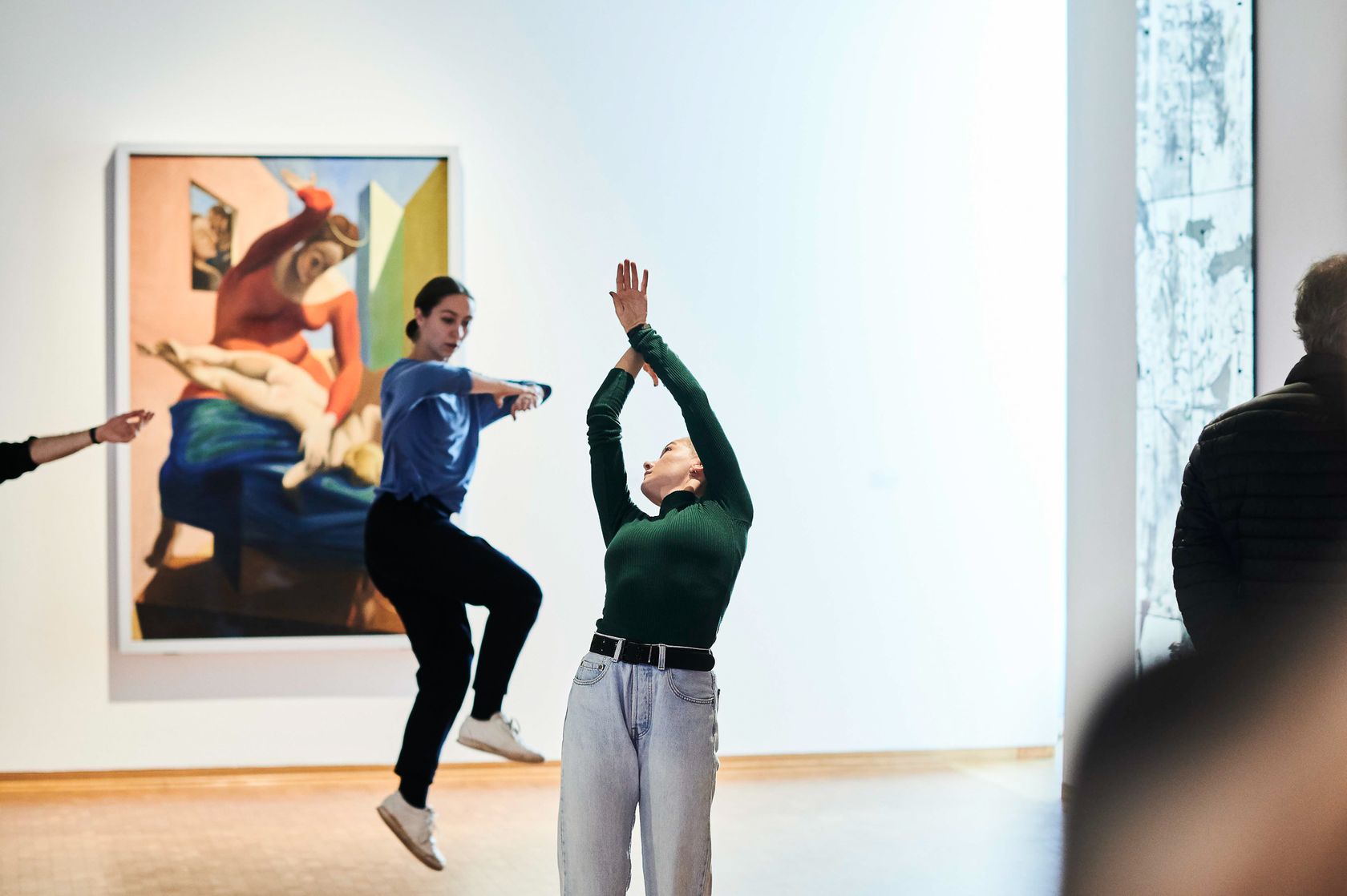
For his second exhibition at the gallery, Nick Mauss presents a new body of work in the spaces located on the second floor at 10 rue Charlot.
Over the past two decades, Nick Mauss has developed a practice that subverts categorization and refuses any hierarchy between media, connecting painting, gesture, memory, and implications of space with writing, performance, and display.
For this exhibition, Mauss focuses his process of reverse-painting mirrors to the scale of the viewer's gaze, folded onto closed volumes that appear to be devices for reflecting oblique slivers of space and social performance. Painted “derriere le miroir”, these objects stand in dialogue with a series of works in etched, double-dyed silk-velvet that are made through a process of chemical subtraction, by which traces of figures and painted marks are literally “unwoven” into the textile. Among these reverse-painted and “devoured” motifs, Mauss introduces hollow, wall-mounted figural heads in sheet-aluminum. The fragile negative molds are formed on enlarged replicas of modernist-archaic heads created in the 1920s by Eyre de Lanux, an artist, writer, and designer whose work has figured in several of Mauss' previous exhibitions, and who returns here, in estranged form, to Paris, where she lived and worked with Eileen Gray and Evelyn Wyld, among others.
—
Overlays, cancellations, overflows
Aurélie Verdier
How to Live Together
What antiquity called the proscenium resulted from the fusion of the ancient Greek (circular) and Roman (semicircular) theatres. It was here that Greek actors “come out and perform in front of it”, on this forestage. For Roland Barthes, this Greco-Roman fusion conjured up a zone of desire emanating from the “conflict between the rectangle and the circus”1.
On closer inspection, the object named exhibition is also a point of convergence for relations of desire—social, aesthetic, political—circumscribed within a space. The open form of Nick Mauss’s (b. 1980, New York) exhibitions generates synergies and tensions that articulate a given, specific space, itself, too, a potential proscenium. And for all that makes them unique, it seems that the same question—a question of living together—runs through them all: what are we to do with our communities—corporeal, spiritual, political? For Barthes, the answer took the form of a seminar in 1976 and 1977 entitled, appropriately, How to Live Together. At the core of his inquiry he placed the idea of communities conveyed by a desired rhythm operating, according to a word he coined himself, on a principle of idiorrhythmy. Barthes imagined forms of productive life adopted by “small, flexible groups of several individuals who are attempting to live together (within a certain proximity to one another), while each preserving his or her rhuthmos”2. To which he added that absence itself is what creates the arrangement: “Different groups spread around an uninhabited centre = the very principle of idiorrhythmic organizations (I’d like a less voluntarist term: constellations?)”3. The seminar was itself research in action: conceived with its audience which, in return, submitted its own idiorrhythmy to him.
Nick Mauss’s work—painted, drawn, staged, choreographed—constantly brings other works into play, works that stand in for new alterities. Rarely has working with other artists (but also through them, which is a different matter) taken on the active significance it assumes through Mauss. With him, creation is sustained by the idea—radiant, or “radial” as Barthes would have said—of transmission.
Drawing is the substrate and methodology from which the artist builds relations of intensities. The medium of drawing—on mirror, aluminum, ceramic, velvet or even paper, to mention just a few—may well nurture an intimate relation with the very idea of text, in the sense given it by the author of A Lover’s Discourse. In How to Live Together, Barthes returns to the written page and how he uses it: “an aspect with walkways and exits; appraising distances and the roles played by sections hidden from view at will: order of reading without violence, etc.”4. As an artist of invitation and transmission, it seems to me, this movement of “walkways and exits”, of non-authoritarian readings, sets bodies and narratives in motion. These, in turn, form the historical counter-narrative that Mauss has long indexed to his own work—against the grain of the hypocrisy and imperialism in narratives of hegemonic modernity, illusorily singular.
For close to two decades now his projects have set archives and artworks in motion as testimonies to those eccentric sociabilities that make up the very fabric of modernisms. These are the materials of his exhibitions, composed in the manner of an entre-sort choreographed according to the invitations initiated by each project. And there is something of a demand made upon the very location of the exhibition in the attention Mauss pays to what he sometimes calls the needs, uses and feelings of an interior space. The relation to a narrative or gesture, to a collection or archive, to an overlooked historical figure and their networks of sociabilities, to an architecture, are constants of his work. Each of the media Mauss uses is profoundly relational, producing authentic relations of ceramic, glass and mirrors, relations of gauze or tulle, relations of velvet. Invoking Barthes once more: between two meanders at Le Palace in the late 1970s, you come across the expression “euphoria of relation”5 in his notes. About a rendezvous, we find that: “Frédérique, who was wearing a rather formal gown, whose unusual shade of beautiful blue soothed me or at the very least made me euphoric”6.
Overlays, cancellations, overflows
Dispelling any ambiguity—if there ever was any—the artist puts it perfectly: “I am always looking for a support that does not already signify, or rest within itself”7. The unpredictability of materials and the effects triggered by the techniques used—dévoré velvet, a stain or solarization of a reverse painting on glass—obviously proceed from their deepest nature, that is, they are labile objects, objects of experimentation. Nothing is settled in advance, and yet everything holds—on condition that the accident be allowed to occur. A fundamental instability of the material constitutes the condition for the appearance of these desired interferences, similar to the deliberate gap in a lip sync. The devouring of velvet is itself a form of interference inscribed within the material. The work always offers its own surface of inscription. The paint applied to the glass support is ultimately entrusted to the randomness of the mirror’s reflective layer. There is a particular light that emanates from reverse-painted mirrors, and it is not that of Narcissus gazing at his reflection. Mauss’s mirror is instead an act of suspension: pure contingency, pure interference.
A work by Mauss is an emanation of other works. For ultimately, it is these works—whether present or not—that form a procession of afterimages. Hence the idea that each drawing, each mirror is essentially a block of memory containing within its own obverse—forgetting. And it is this dialectic, this, let’s say, “memory of forgetting” that impresses the material, physically incises and prints it. The work operates by contamination or by ellipsis, by which we understand whatever is located elsewhere, spatially, but has left its trace. In Mauss' work, tool and gesture retain a desired fragment, a lingering object, like a memory resurfacing, or an image conceived after the fact. And his drawing alternates between two apparent opposites—on the one hand the deep gouge, an incision into the material, and on the other the surface trace. Painting on glass is a process of inversion, to which Mauss adds a layer or a stratum, with a literally blind result: for the mirrored layer comes only after the underside of the glass has been painted, “trapping," in a sense the traces paradoxically incised in depth and not on its surface.
*
Mauss’s drawing is strewn with fetishizable fragments, similar to what Barthes invokes, in the famous Gradiva, that female figure represented “walking, one foot raised”8 on a bas-relief found in the ruins of Pompeii, and whose name means “She who advances”. Elsewhere, too, the semiologist notes the effect of cut, of cleaving, proper to the fetish: “It’s as if imaginary perversion imperiously requires the frame, the rectangular excision, encompasses it”. And Barthes lists the instances and sites of the desired detail: “Cf. Loving enchantment, love at first sight, to be suddenly enamored = to be kidnapped by the image. Now, as a general rule, that image is framed. The object of love (the object to be loved) abruptly appears (a) as a cut-out silhouette—or as a particular, fetishizable part of the body, (b) in a frame, (c) in a setting, in the act of doing something”9. Barthes’ analysis evokes the profoundly choreographic nature of Mauss’s work in its imaging capacity. Both opulent and undone, his work has this capacity for action: it is an exercise brought to its point of maximum tension and, simultaneously, to its point of release.
As to the rectangle of the Greek theatre stage, Roland Barthes further elaborated that it was designed to be subverted: “subversion of a form or archetype is not necessarily accomplished by means of the contrary form, […] but by inventing a set of overlays, cancellations and overflows for it”10. In 1930, a small sketch by Natalie Clifford Barney entitled “Temple à l’Amitié”11 brought to light the sociabilities operating in her Paris salon. It was a kind of multidirectional latticework of names, names of friendships overlaying one another, cancelling each other out and overflowing. In the same way, drawing insinuates itself everywhere in Mauss' work: as a force of idiorrhythmic interaction, it suggesting how to live together.
1 Roland Barthes, Comment vivre ensemble (How to Live Together), seminar at the Collège de France, ed. Éric Marty, Paris, Seuil [for transl. see Rectangle, in How to Live Together. Novelistic Simulations of Some Everyday Spaces. Trans. Kate Briggs, Columbia University Press, New York, 2012], p.115.
2 Roland Barthes, Cause, in How to Live Together, ibid. p.43.
3 Roland Barthes, Room, in How to Live Together, ibid. p.51.
4 Roland Barthes, To take my leave and fix a new appointment, in How to Live Together, ibid. p.169-170. Emphasis mine
5 Barthes, Roland. Soirées de Paris [±Paris nights], in Incidents. Trans. Richard Howard, Berkeley: University of California Press, 1992, p.73.
6 Ibid, p.53. Trans. complemented by Simon Hamilton.
7 Nick Mauss, Intricate Others, exhib. cat. Serralves, Porto, Mousse Publishing, 2017, p.15.
8 Rectangle, in How to Live Together, op. cit, p.115
9 Ibid, p.115. Emphasis mine.
10 Ibid, p.116. Trans. Simon Hamilton.
11 Temple to friendship, trans.